
Mental Health
A functioning brain is a complicated system.

From Tuesday, July 15th, 2025
Mental Health
This is a diagram of a normal human brain:
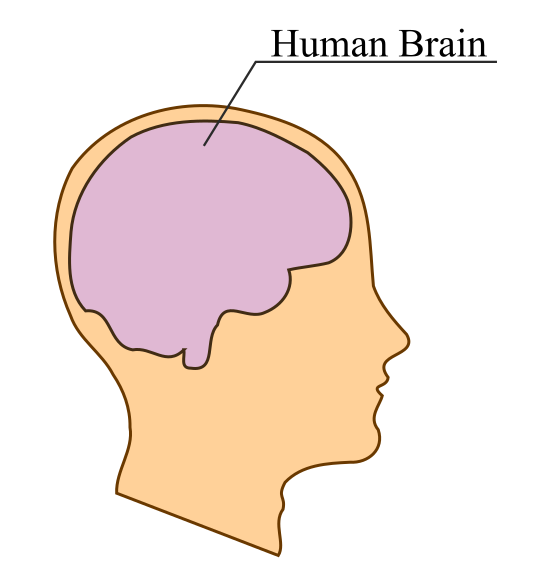
As you can see, a normal human brain takes the form of a human brain. It has one main constituent part, which is the brain part.
This is a diagram of my brain:
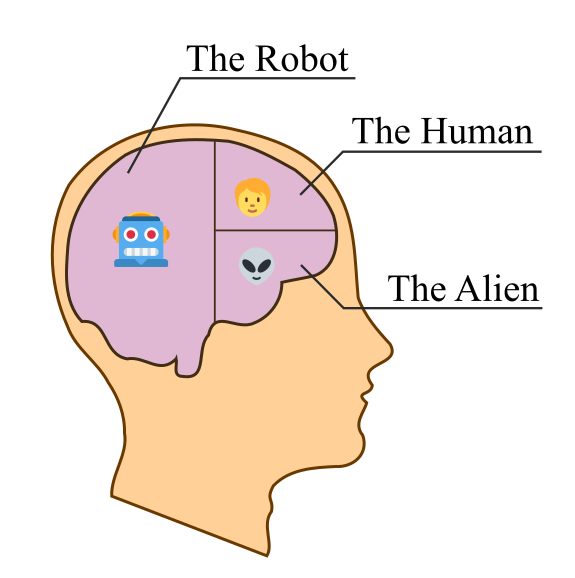
You might be able to spot a few differences.
My brain didn’t always look like that! There didn’t use to be a human in there.
The Robot
The robot part of my brain works the way you’d expect it to: it’s mostly concerned with logic, reason, and trivially unfalsifiable arguments. It was in charge for about the first twenty years of my life. If you said “Hi, Mitch” to me, I would respond with “hello” and then await further instructions; I didn’t want to guess what I was supposed to say next. If someone asked me what the best thing to do on the playground was, I would hesitate and list the pros and cons of the swing set vs. the jungle gym; if someone asked me what my favorite thing on the playground was, I would perceive the question as having no correct answer and become unable to respond. I saw people around me talk to and interact with each other on a regular basis in mysterious patterns; I wanted to do the same thing, but I didn’t understand that people’s interaction patterns were driven by underlying relationships. I would try to talk to people, but I would talk to someone for the fiftieth time with the exact same affect and mannerisms as I would talk to anyone for the first time; I didn’t understand that as two people got to know each other, the way that they interacted was supposed to change. (If I and they were still both the same person, why would we interact with each other differently?) I was mostly preoccupied with behaving in ways that an alien, with no knowledge of humans or human social customs, would be unable to judge to be illogical or wrong.
The Human
When I was 19 years old, during the first few minutes of a calculus class, I suddenly gained the ability to read minds. (I don’t think the fact that I was in calculus is relevant, but who knows.) And when I say “read minds,” I mean “perceive the social expectations that someone had for me during my interactions with them.” Suddenly, I now knew that when I saw someone I had talked to before, I was supposed to say “Hi” to them for no reason, and that I could choose what to say next based on what I knew about them from previous interactions. I wasn’t supposed to make sure what I said was always “correct;” I could make statements that were instead grounded in personal preference and opinion and that factored in other people’s personal preferences and opinions. I could try to be human now.
Which all felt kind of insane? The human is crazy. By which I mean, the things that the human decided it should do seemed like completely bizarre, nonsensical, pants-on-head insanity to the robot. “Why would you say ‘hi’ to someone just because you notice them? What does ‘hi’ mean or convey in that scenario?” (I cannot stress enough that this is not me being contrarian and trying to question ubiquitous social norms to seem clever and subversive - this is the way that the largest part of my brain has always thought.) Which put me in a weird position: to escape from the soul-crushing boredom and emptiness that had previously defined what it was like to be me, I had to listen to the newest, craziest, and least self-explanatory part of my brain. I had to try to ride the rollercoaster of brand new wild ideas (things like “ask that person who sits behind you in Spanish class about their cat”) while trying to stumble through a lot of different interactions for the first time (things like randomly being invited to ride in someone’s car to get coffee, which registered like I was being pulled onto a spaceship and launched up towards the Moon) and constantly analyzing my own behavior with every part of my brain to try to figure out if I was still being weird (“By the way, for an unknown reason, it would seem strange to ask someone about their cat every single time you see them.”) For plenty of reasons, I had to listen to the human part of me. But I didn’t trust it. I still don’t.
The Alien
We’re not actually going to talk about the alien.
The Rollercoaster Ride
It took me a long time to get used to the new set of instincts that had been grafted onto my brain. At the end of 2018, when I was 20, I wrote that the past year had felt way longer than any year ever had before, which is the opposite of how you’re supposed to experience time when you grow older. In 2019, I made my first friend online when I made a long Tumblr post reviewing a psychology paper about trust, trauma, and the feeling of a “foreshortened future.” In 2020, I made my first friend in real life (here operationally defined as someone who I met up with to hang out with outside of a school or work context more than once.) My everyday experience of the world was still pretty rocky; I was still agitated and confused when trying to figure out what to say to the person at the drive-through window when they said “have a nice day” and handed me McDonald’s.
When I moved out and went to college in 2022, I was forced into so many random interactions of that type that I gradually gained confidence in my ability to survive them with whatever random script the human part of my brain supplied me with. Was I actually perceived as normal, or was I just forcing my way through interactions with enough confidence to not notice confused reactions from people? Who knows, but I didn’t have the time or energy to worry about it anymore. I had a weirdly successful on-campus college career, considering - I became the president of the biggest student organization in my major, got selected for one tutoring and two research jobs by professors, and didn’t flunk anything that badly. My life had stopped being boring. Was I succeeding at being human?
I don’t know? The human is still kind of a new thing in my brain, and still kind of sucks at its job. I sort of understand friendships; I’ve had, like, three, or maybe as many as five if you count friendships online. (Those numbers could be way, way off if I’m wrong about what counts as a “friendship”, so like, probably.) I definitely don’t understand friend groups; trying to keep track of a whole bunch of people in a social situation at once still makes me feel overwhelmed and insane, even though I know a friend group is supposed to become a neutral environment where you can just kind of be yourself. (Which self am I supposed to be being?) If I trust my own human instincts too completely, I inevitably have to confront the fact that they have no experience, no idea what they’re doing, and thus probably aren’t great at their job. (I know that Freud is kind of old hat, but in his three parts of the psyche, the human clearly corresponds to the ego, and too much ego is a dangerous thing.) If I don’t trust them at all, life becomes quite difficult, and I have to spend hours (literally) building up the courage to go through the drive-through at McDonald’s and be told to have a nice day1. I depend on the human not just to understand current and future relationships prospectively, but also to understand all past relationships and interactions with other people retrospectively; if it’s wrong about stuff, it could be wrong about the acceptability of all the friendships and drive-through interactions I’ve had in the past, which wouldn’t be great news. (Different people have quite different expectations for random retail interactions.)
Appendix A: So Are You Autistic
Probably? I’ve been asked that before, although ironically not for the first twenty years of my life - the community where I grew up was kind of rural and not super culturally aware of mental health issues or neurodivergence, and it seems like you might have to be recognizably trying and failing to be a normal human before people notice you enough to consider whether you might be autistic, as opposed to thinking you’re just anti-social and weird. I have some test results from a mental health clinic that are consistent with an autism diagnosis, but the doctor in charge of evaluating me didn’t seem that interested in them and mostly focused on test results pertaining to emotional health in his report, and I had to have an hour-long argument with a psychiatrist just to get tested for that at all. At some point, I gave up on pursuing that validation.
The difference between me and the autistic people I see online is that they don’t seem to make the distinction that I make between the human and the robot in their mind and behaviors; they see their own neurodivergence as something that’s part of them in the way that blue and red paint blend together to make purple, whereas I feel like I have a blue stripe and a red stripe. Even though it was the best I could do, I’ve always known that I was really, really, really bad at socializing in robot mode, as evidenced by the first twenty years of my life, and so I feel like I have to keep the more normal-human part of me separate from that as much as possible.
Footnotes
-
“It is the phenomenon sometimes called alienation from self. In its advanced stages, we no longer answer the telephone, because someone might want something; that we could say no without drowning in self-reproach is an idea alien to this game. Every encounter demands too much, tears the nerves, drains the will, and the spectre of something as small as an unanswered letter arouses such disproportionate guilt that one’s sanity becomes an object of speculation among one’s acquaintances.” - Joan Didion, On Self Respect ^
Tagged as personal.